The ADI career, honestly
What the job gives, who it suits, and why it matters — before you spend a euro on the exams.
Why Become an ADI?
Explore the key benefits of an ADI career, including flexibility, earning potential, industry demand, and the qualification path.
The ADI career offers flexibility, autonomy and reported earnings of €35,000–43,000 a year — self-employed, typically 20–30 lesson hours a week, and genuinely useful work. Demand is underpinned by the EDT mandate (12 lessons per learner) and a 2026 permit change reported to affect 64,000+ long-term learners. It suits patient teachers and career changers, and entry is three RSA exams starting with the Stage 1 theory test.
Six reasons to make the jump
The independence of self-employment with the stability of a regulated, in-demand profession — with the honest caveats attached.
Be your own boss
Self-employed with full control — no manager to report to. You decide how to run the practice, market it, and how fast to grow.
Choose your hours
No fixed 9-to-5. Mornings, evenings, weekends or a mix — most ADIs settle around 20–30 lesson hours a week.
Pick your clients
Your area, your niche: nervous drivers, teenagers, refresher lessons or EDT-only learners. Your rules.
High job satisfaction
A life skill, taught by you, with a visible outcome every time a pupil passes. Few careers show their impact so directly.
Set your own rates
Reported lesson rates run €25–45 per hour by location and experience — Dublin at the top of the range, regional areas with less competition.
Scalable business
Start solo, then hire other qualified ADIs, widen the coverage area and build a recognisable local brand.
ADI career vs the office job
How the career stacks up against a traditional office role, factor by factor.
| Factor | Office job | ADI career |
|---|---|---|
| Schedule | Fixed 9–5 | You choose your hours |
| Boss | Report to management | You are the boss |
| Commute | Daily commute to an office | Your car is your office |
| Earnings ceiling | Salary set by employer | Set your own rates (€25–45/hr reported) |
| Job satisfaction | Varies | Help people achieve independence |
| Scalability | Limited by employer | Build your own school |
| Dress code | Office attire | Smart casual |
| Location | Tied to the office | Work anywhere in your area |
The numbers behind the demand
Ireland’s learner pipeline creates consistent, growing demand for qualified ADIs.
There are 140,000+ learner permit holders in Ireland and roughly one instructor per 2,000 people. Every learner must complete 12 EDT lessons with a registered ADI, and long driving-test waiting lists keep lesson books full. For the county-by-county picture, see our market analysis.
2026 demand boost: from November 2026, learners must sit their driving test within 4 years of their learner permit or face non-renewal. Reporting suggests this will push 64,000+ long-term learners to take lessons and tests — and every one of them needs 12 EDT lessons from a qualified instructor.
Could this be your story?
The ADI career attracts people from all walks of life — four arrivals we see again and again.
The office worker
Stuck at a desk? There is another way.Escape the 9–5 grind: as an ADI your car is your office, you set the schedule, work out in the world and choose your clients. Many of Ireland’s ADIs came from office or corporate backgrounds.
The transition is straightforward — the qualification process is commonly reported at 6–12 months, and a trainee licence lets you earn before fully qualifying. See a typical day to preview the new working life.
The parent
Want to work while the kids are at school?Work school hours, take school holidays off, and be there for pickups — no childcare needed during working hours. Mid-morning and early-afternoon slots are a genuine lesson window.
Many parents find the working hours align with family life: you control the diary, so you never choose between work and being present.
The car enthusiast
Love driving? Make it your career.If you’re passionate about cars and driving, the ADI career turns that into a profession — a working day spent behind the wheel, sharing knowledge and building other people’s confidence on the road.
Discover why this is considered a valuable career for those who genuinely enjoy the craft of driving.
The self-starter
Ready to be your own boss?Build a business from day one: set your rates (€25–45/hour reported by location), choose your working area, and grow at your own pace — many ADIs expand from solo into multi-instructor schools.
Check the entry requirements and qualification pathway to see if you qualify, then review the costs to plan the budget.
Who it suits
Four kinds of people thrive in the driver’s seat next to the driver’s seat.
The patient teacher
You explain without condescending and celebrate small wins. Teaching ability is a scored exam section for a reason.
The career changer
No degree required — a full licence held two years and the will to pass three tests. Many ADIs come from different careers.
The people person
Every hour is one-to-one with a stranger becoming a driver. If that energises rather than drains you, the job fits.
The safety-minded
You notice hazards others miss and it bothers you. That instinct is the core of the profession and helps you stay focused.
Five traits of great instructors
Not everyone is suited to teaching, and that’s fine — but if you recognise yourself here, the fit is strong.
Passionate about driving.
Driving isn’t just transport for you — it’s something you look forward to. That enthusiasm is infectious and helps learners feel positive about their lessons.
01
Committed to professional development.
The best ADIs keep investing in their skills — ongoing training, current road-safety standards, better teaching methods.
02
Open to change and new challenges.
Every learner is different. You adapt your approach based on who is in the passenger seat; flexibility is essential in this role.
03
Enjoys seeing success in others.
There’s nothing quite like a nervous learner passing their test. If other people’s wins feel like yours, this career pays that out regularly.
04
Appreciates flexibility and autonomy.
Schedule, income, working environment — the ADI career puts all of those decisions in your hands.
05
Is the ADI career right for you?
Tap each statement you’d answer yes to, then see how well the career aligns with your personality.
1. Do you enjoy teaching others?
2. Are you patient under pressure?
3. Do you enjoy driving daily?
4. Do you prefer flexible hours?
5. Can you teach different people?
6. Would you choose self-employment?
Why Instructor Quality Matters
Four reasons the career is valuable
Saving lives, professional standing, career control, and visible impact — the evidence behind each claim.
You save lives
Direct contribution to road safetyADIs train new drivers to national standards, and the record moved with regulation: RSA data shows road deaths in Ireland dropped 44% between 2007 and 2013, the period following the introduction of ADI regulation. Every lesson is a contribution to public safety, not just a booking.
Professional standing
Regulated, credible, protectedADI is a regulated profession — RSA registration carries legal standing, and only registered ADIs can charge for instruction. That regulatory barrier protects the career from unqualified competition.
You control your career
Self-employed, flexible, scalableYour hours, your clients, your rates (€25–45/hour reported), your patch — and a path from solo instructor to multi-instructor school. Salary aggregators report €35,000–43,000 a year for full-time instructors.
You see your impact
Tangible, visible, personalUnlike careers where your contribution is abstract, an ADI sees the direct result of the work. When a pupil passes, you know you made it possible — independence and a lifelong skill, delivered one hour at a time.
Impact in numbers
The data behind the value of the ADI profession in Ireland.
drop in road deaths 2007–13
learner permit holders
EDT lessons per learner
2026 rule change
Making a difference from day one
From your first lesson you are contributing to road safety, and your qualification carries weight as a regulated professional. The RSA registration earned through the three-stage ADI process gives you the authority to deliver the Essential Driver Training (EDT) lessons every learner in Ireland must complete.
Growing market demand means stable prospects: with 140,000+ learner permit holders and regulatory changes ahead, qualified instructors are needed now more than ever. Whether you’re weighing a career change or exploring options, this is a profession where the work has real, measurable value from the start — see who should consider it if you haven’t already.
Get Your Free ADI Starter Kit
Become an Approved Driving Instructor in Ireland — free, online.
Built for the current exam cycle — weighted like the real paper.
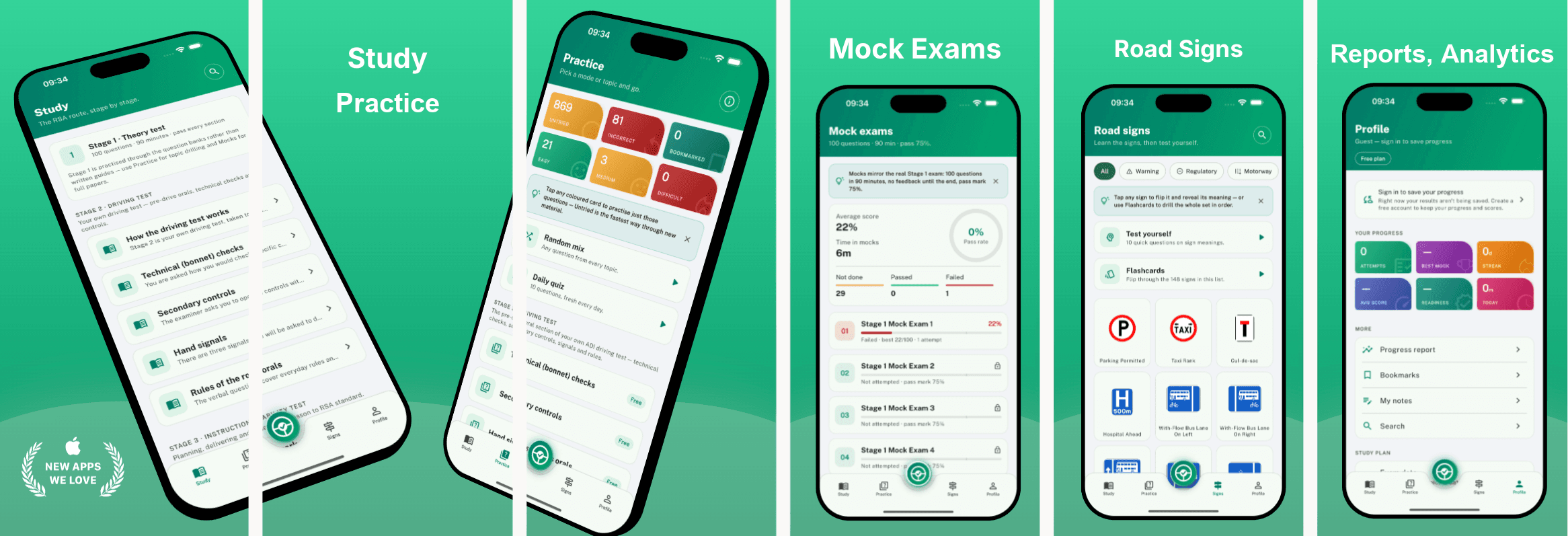
Every question is tagged to the five RSA sections, and the 30 mock exams mirror the real 100-question weighting.
What’s inside the starter kit
Five things you’ll have open in your browser within the next minute — no email to wait for, no PDF to download.
Full three-stage qualification roadmap with timelines
ADI cost breakdown — €800 minimum
The five exam sections and their pass marks, explained
88 free practice questions plus the free study guides
Earning potential and career outlook for ADIs
Get your free starter kit
Takes 30 seconds1,000
Questions in the bankAll 3
Stages covered30
Weighted mock examsHow to capture these benefits
Knowing the upside is step one — here is how to position yourself to take advantage of it.
01
Qualify ahead of the 2026 surge.
The earlier you start, the more established your client base will be when the permit deadline lands — and Stage 1 is the gate to everything after it.
02
Consider your location.
Dublin commands higher reported rates (€35–45/hr) while regional areas have less competition — both approaches work. See who should consider this career to assess your fit.
03
Build a client base on the trainee licence.
After passing Stage 2, the optional trainee licence lets you teach (and earn) while you prepare for Stage 3.
04
Understand the qualification process.
Three RSA stages from application to registration — our stage-by-stage guides map the pathway, and the free study guides cover the theory.
05
Know the investment.
Training, exam fees and registration typically cost a few thousand euro, often recoverable within weeks of full-time teaching. See the cost breakdown for details.
The career, Answered
Yes. As a self-employed ADI you choose when to work — most instructors deliver 20–30 lesson hours a week and schedule around school runs, other commitments or a second income. See the typical day page for how the hours fall.
Salary aggregators report roughly €35,000–43,000 a year, with lesson rates from about €25 in regional areas to €45 in Dublin — before costs. Income depends on hours worked, rates and location; treat every figure as a range, not a promise.
Industry reporting suggests yes. The EDT mandate requires 12 lessons per learner from a registered ADI, and from November 2026 learners must sit their test within four years of their permit — a change reported to affect 64,000+ long-term permit holders. See the market page for the full picture.
Yes. Many ADIs start solo and grow into multi-instructor driving schools — hiring other qualified instructors, widening the coverage area and building a local brand. That scalability is one of the career’s strongest advantages over traditional employment.
No degree or teaching background required. You need a full licence held 2+ years, Garda vetting, tax compliance and the ability to pass the three RSA exams — a process commonly reported at 6–12 months. Many ADIs come from office, corporate or trade backgrounds.
It’s one of the classic fits: you set your own schedule, can work while the kids are at school, take school holidays off and avoid childcare costs during working hours.
A love of driving helps, but teaching skills matter more — patience, communication and adapting to different learning styles. Many successful ADIs are driven more by their enjoyment of teaching than their love of cars.
Patient, communicative, adaptable, and energised by helping others succeed — staying calm under pressure and explaining clearly to nervous learners. If people naturally come to you for help or advice, that’s a strong indicator.
By training new drivers to national standards through the 12 mandatory EDT lessons. RSA data shows road deaths fell 44% between 2007 and 2013, the period following the introduction of ADI regulation.
Yes — ADI is an RSA-regulated profession with legal standing. Only registered ADIs can charge for instruction, entry requires three exam stages, and standards are maintained through ongoing check tests.
Unpaid accompaniment is allowed — anyone 21+ holding a full licence for 3+ years can sit with a learner. The register is only required the moment money changes hands.
Two things: Stage 1 is underestimated, and self-employment admin is real. Both are learnable.
The career starts with one exam
Stage 1 is the only stage you can fully prepare for at home.