ADI theory test questions
Free sample questions for the RSA ADI Stage 1 exam in Ireland, with answers explained.
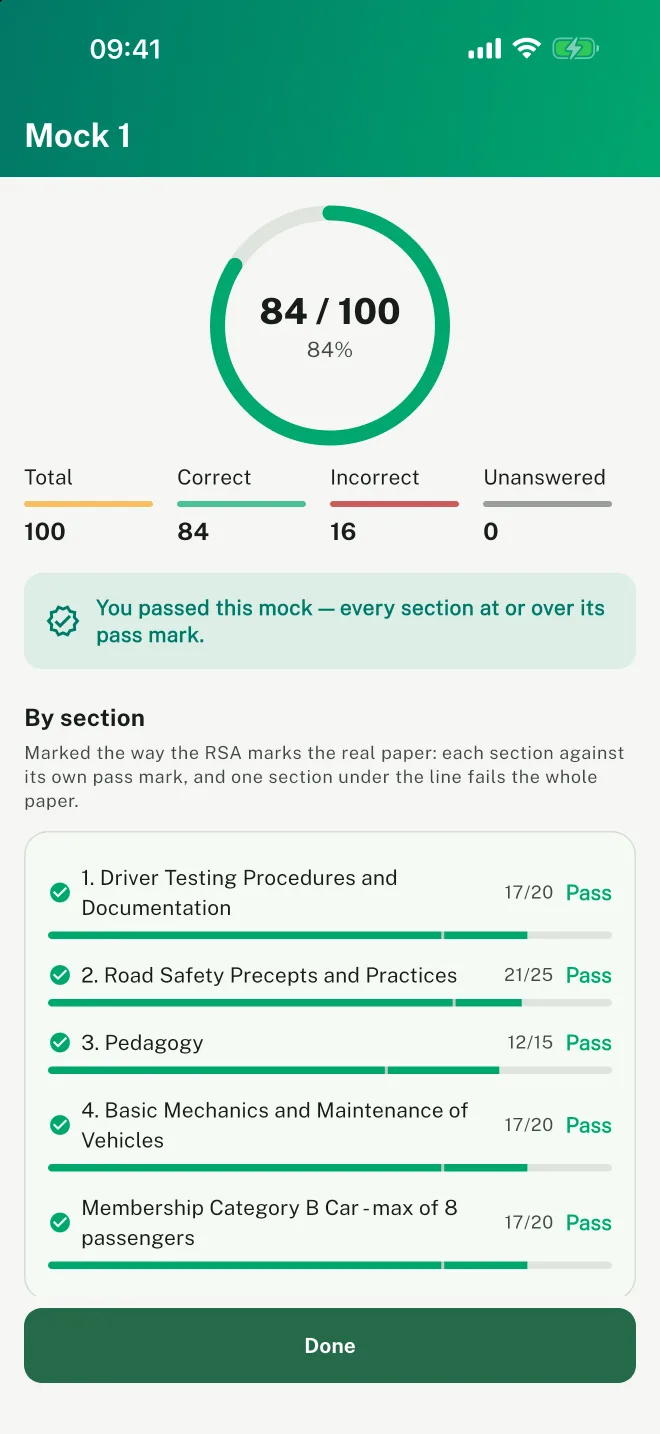
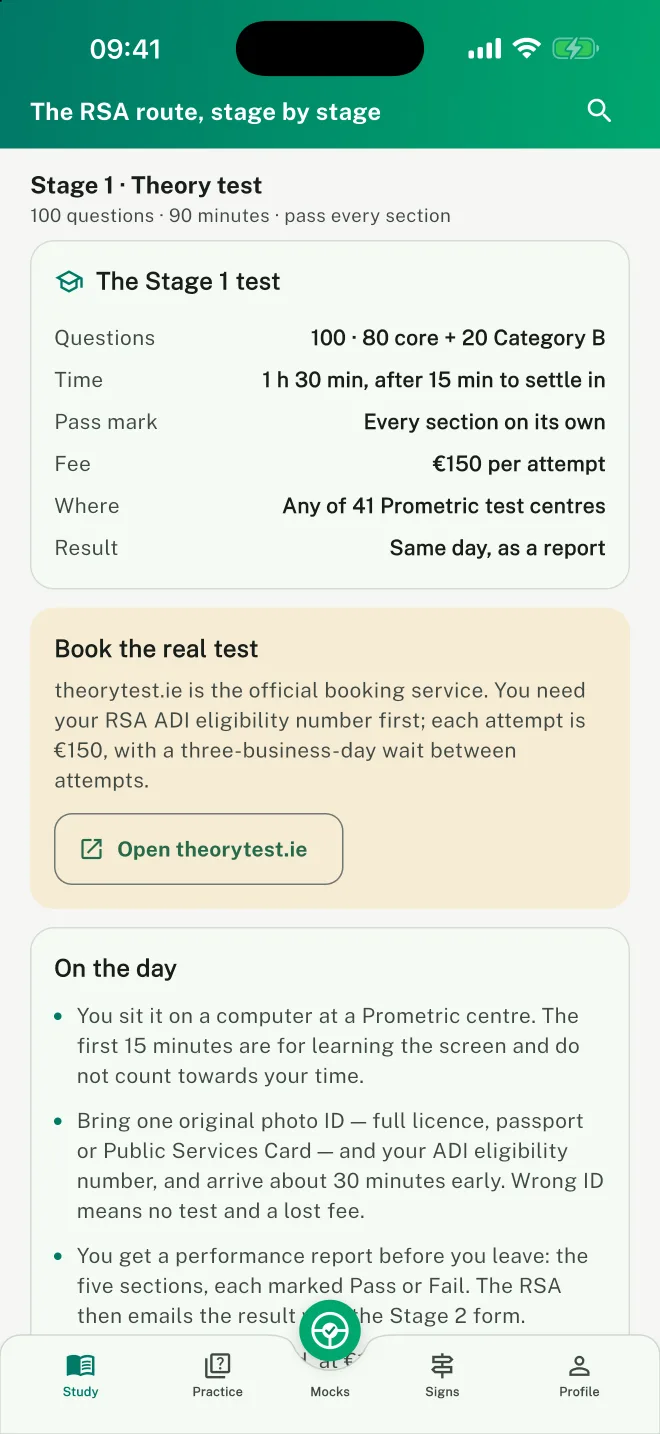
The ADI Stage 1 theory test is 100 multiple-choice questions in 90 minutes, across five sections that are each passed separately. Below are 12 questions from the PassADI bank, drawn from different topics. Try each one, then open the answer to see why it is right.
Sample Stage 1 questions
Which of the following conditions must all drivers report to the NDLS after their first licence is issued?
- Aany family history of cataracts or glaucoma
- BNo need to update eyesight issue
- Cshort-sightedness
- DAny visual problem affecting one eye OR Prescribed glasses for driving use
Show answer
Answer: D. Any visual problem affecting one eye OR Prescribed glasses for driving use
Visual problems affecting an eye, or a requirement to wear corrective lenses for driving, must be declared so the licence record is accurate — the corrective-lenses condition (code 01) is then shown on the licence. General family history or minor uncorrected short-sightedness within the standard is not what the reporting rule targets.
A learner who benefits most from written notes, handouts, and reading signs is likely to be a
- AKinesthetic learner
- BRead/Write learner
- CAuditory learner
- D. Impulsive learner
Show answer
Answer: B. Read/Write learner
A read/write learner absorbs information most effectively through text — written notes, handouts, manuals and signs. A kinesthetic learner would instead want to learn by physically doing the task.
What is the correct tyre pressure for your car?
- AAlways 32 psi
- BCheck the driver’s manual or inside door frame
- CWhatever feels best
- DThe same for all vehicles
Show answer
Answer: B. Check the driver’s manual or inside door frame
Correct tyre pressures are specific to each vehicle and load, so check the driver's manual or the plate inside the door frame (or fuel flap). There's no universal figure like 32 psi, and guessing by feel leads to under- or over-inflation.
Having stopped and waiting in traffic, you should avoid dazzling drivers behind you by:
- Aspeed ahead to escape
- BBy applying handbrake only
- Cconfront them at a traffic light
- Dapplying the footbrake only
Show answer
Answer: B. By applying handbrake only
When stopped in a queue, applying the handbrake and releasing the footbrake switches off your brake lights, which would otherwise dazzle the driver behind — especially at night. It also secures the car more safely than resting on the footbrake.
When braking, in forward gear/motion extra weight is thrown onto:
- Ainitially the rear wheels, thereafter the front wheels
- Bthe rear wheels
- Call four wheels
- DThe front wheels
Show answer
Answer: D. The front wheels
Under braking, weight transfers forward onto the front wheels — which is why the front tyres do most of the braking work and generally wear faster.
Applications for entry onto the instructor register should be made to
- AThe RSA ADI Unit
- BThe Driving Testing Services In Ballina Co Mayo
- CThe Local Driving Test Centre
- DDepartment Of Transport
Show answer
Answer: B. The Driving Testing Services In Ballina Co Mayo
Applications for entry on the instructor register go to the RSA's driver testing service based in Ballina, Co Mayo, where the ADI Register is administered.
Advising a pupil on the routine for moving away from the kerb, you would say:
- AFirst use the mirrors, then signal and look around
- BSignal, look around, use the mirrors
- CLook around, use mirrors, signal if necessary
- DUse the mirrors, signal if necessary, & look around
Show answer
Answer: D. Use the mirrors, signal if necessary, & look around
Mirrors, then signal if a signal would help anyone, then a final look around the blind spot before moving. The signal is conditional and the blind-spot check comes last, immediately before you move.
Why is low sulphur diesel used in modern cars and vans?
- AIt improves vehicle acceleration and top speed
- BIt increases sulphur emissions for better engine cleaning
- CIt reduces harmful emissions and protects emission control systems
- DIt makes the fuel cheaper and extends oil change intervals
Show answer
Answer: C. It reduces harmful emissions and protects emission control systems
Low sulphur diesel reduces harmful exhaust emissions and protects modern emission-control equipment such as catalytic converters and particulate filters, which sulphur would damage. It is an environmental and engineering measure, not a performance or cost benefit.
What happens if you drive a vehicle above your licences MAM limit?
- AYou pay a toll
- BIt's illegal and unsafe
- CYou are taxed more
- DReduces fuel efficiency
Show answer
Answer: B. It's illegal and unsafe
Driving a vehicle above the MAM limit of your licence category is illegal and unsafe — you are unlicensed for that vehicle, which also invalidates your insurance. It is not a matter of tolls, tax or fuel economy.
Using too little pressure on the accelerator pedal when moving away
- AMay result in the engine stalling
- Bwill not matter at all in a diesel-engine car
- Cmay cause the vehicle to surge forward
- Dis probably better for the environment
Show answer
Answer: A. May result in the engine stalling
With too little pressure on the accelerator, the engine lacks the power to take up the load as the clutch engages and may stall — in a diesel just as in a petrol car.
What should be adjusted before starting the test drive?
- AHorn, accelerator, clutch
- BTemperature controls, fan, wipers, fog light
- CSeat, Seat belts, mirrors, doors, headrest
- DIndicators, headlights, brakes
Show answer
Answer: C. Seat, Seat belts, mirrors, doors, headrest
Before moving off, the driver should complete the cockpit drill: doors closed, seat and headrest adjusted, seatbelt on and mirrors set. Temperature controls and wipers are secondary controls used as needed, not part of the pre-drive setup.
Learner drivers are most likely to perceive information about the driving task if they are presented with
- AGood visual information and presentation
- BLengthy explanation
- CBrief verbal description
- DCopious notes
Show answer
Answer: A. Good visual information and presentation
Driving is a predominantly visual task, so learners take in information about it best when it is presented visually and clearly. Lengthy verbal explanations or copious notes are much less effective for this kind of learning.
Practise all 1,000 questions
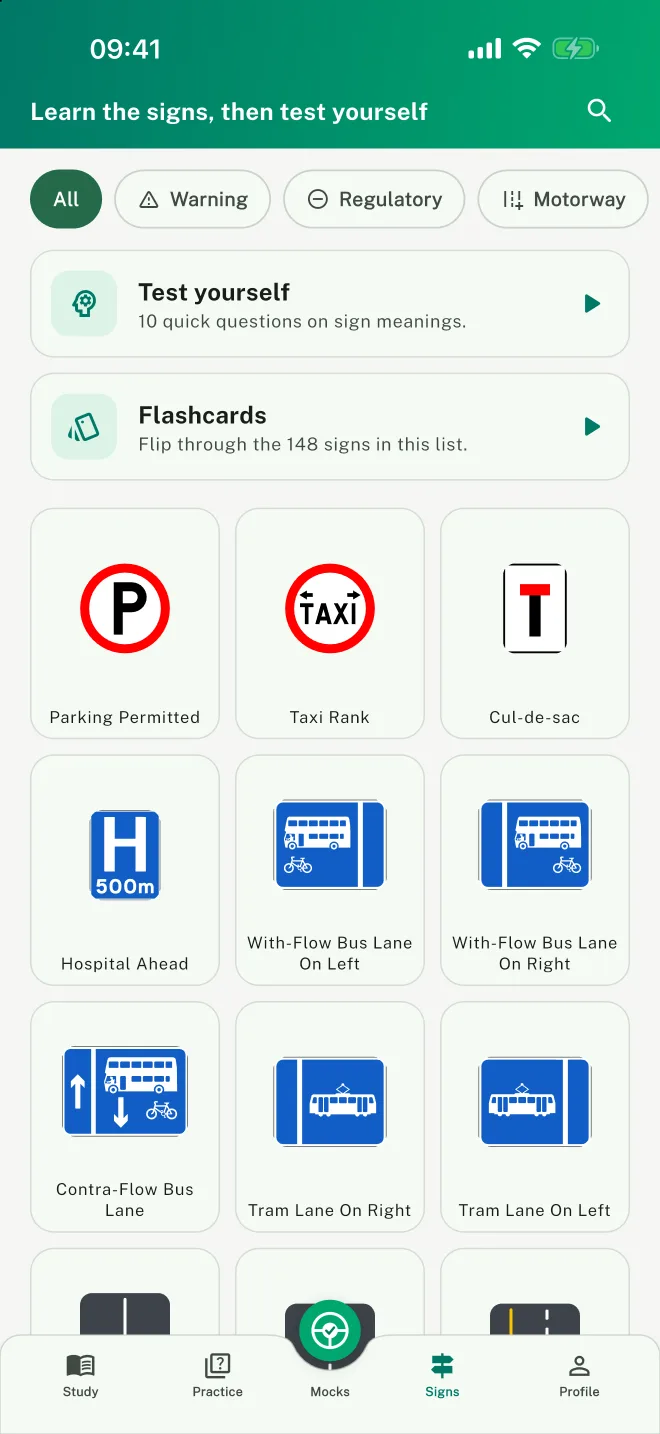
The PassADI app has the full Stage 1 bank, 30 timed 100-question mock exams and every Irish road sign. Start free, no account needed.